Sencelles: verse and prose through the streets
Urban literary routes

Durada
30 min. on foot

On comença
Parish Church of Saint Peter

Distància
775 m

Dificultat
Easy

Equipament
Comfortable footwear and clothing.

GPX
Sencelles: verse and prose through the streets
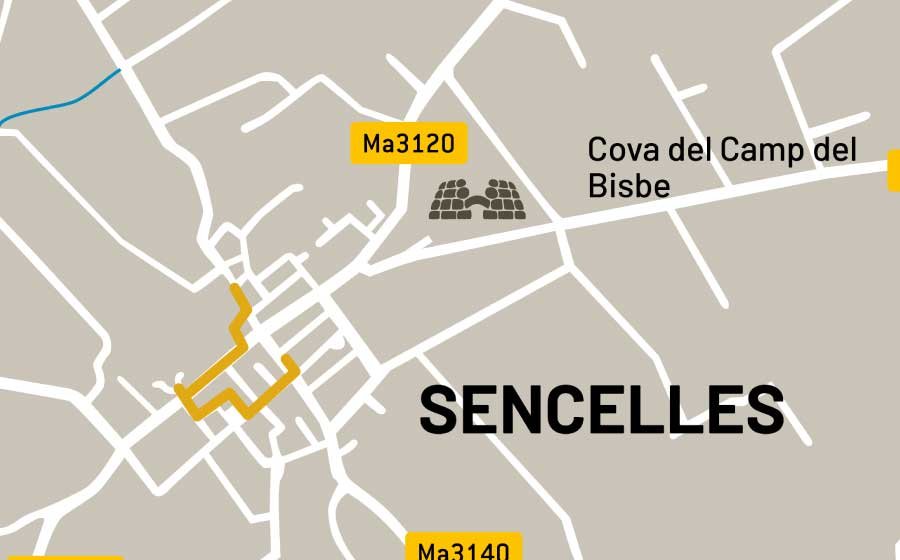
Sencelles is also literature. Verses and stories have accompanied its streets, squares and houses, transforming the town into a space where literary memory lives alongside it. A different outlook, gentler and more attentive, built word by word and seasoned with metaphors, which will give us a different and, above all, richer view. A route to understand Sencelles through the art of the word.
Punts d'interès de la ruta
1
Parish Church of Saint Peter
2
Bell tower of Saint Peter
3
Panel dedicated to Ramon Llull
4
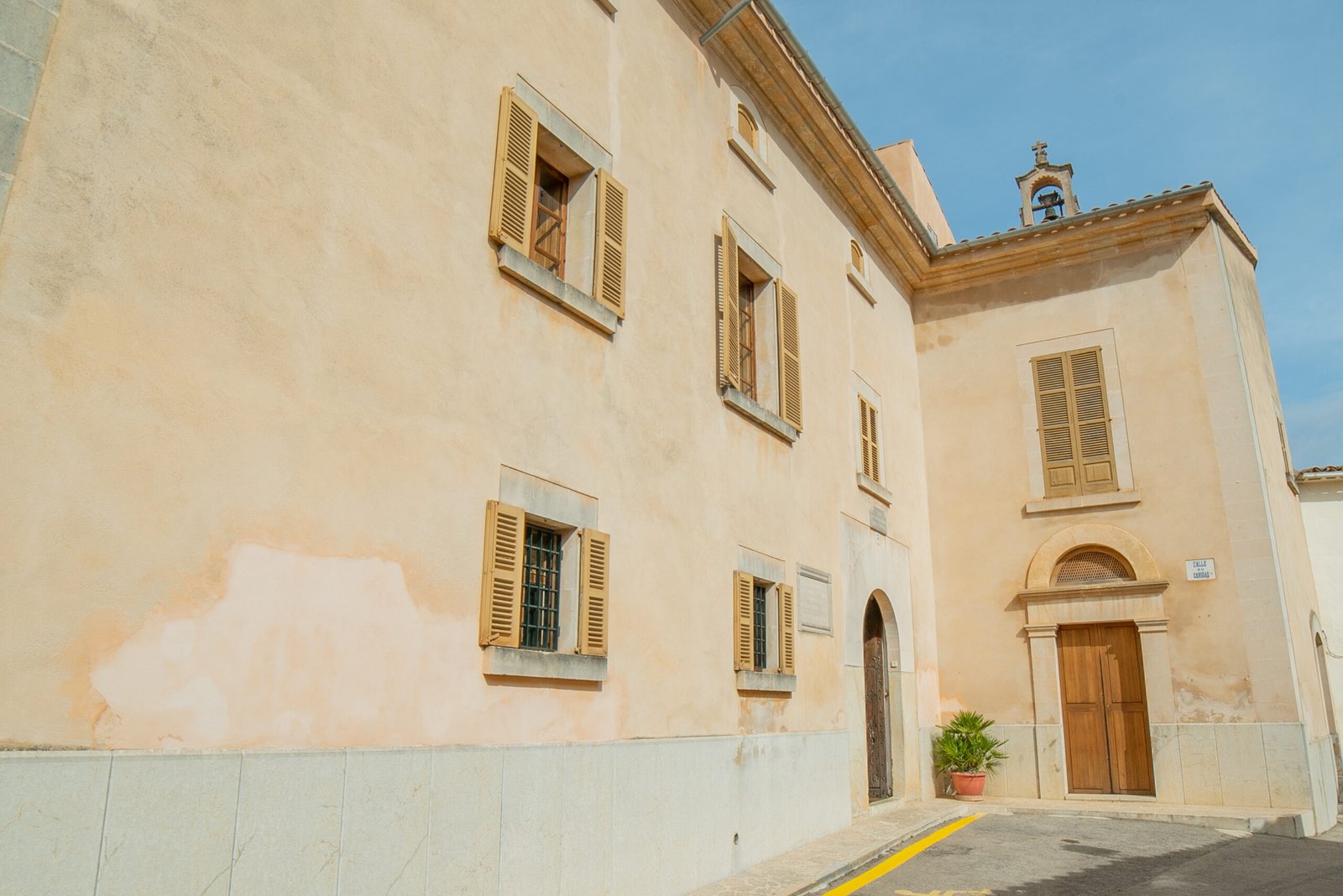
Convent of the Sisters of Charity
5
Posada de can Romanyà
Parish Church of Saint Peter
Antoni Furió i Sastre (Palma, 1798–1853) was a chronicler of the Kingdom of Mallorca. He authored a number of works of great historiographical interest, such as the Diccionario histórico de los ilustres profesores de las bellas artes en Mallorca (1839) and, above all, the Panorama óptico-histórico-artístico de las islas Baleares (1840), from which we reproduce this passage from the chapter devoted to Sencelles (translated from the original Spanish):
"In Sancellas the traveller does not find the same splendour and magnificence in the streets and buildings that he admired in Binissalem, nor that open and urbane character that distinguishes the people of that town; although the simplicity and good faith of the people of Sancellas make them likeable, and if they seem somewhat reserved, this should be attributed to the scarcity of visitors. Going up and down narrow, poorly aligned streets, we reached our lodging just as the bells were ringing to call the people to the main mass: following the crowd, we found ourselves inside a temple unique in that town, whose nave we considered too small to shelter the 2,354 souls that make up its population. The temple is of modern construction, well kept, and its main altar is tasteful, upon which stands the statue of its patron, Saint Peter, seated in a magnificent chair, robed in pontifical vestments."
Bell tower of Saint Peter
The poet Victorià Ramis de Ayreflor (Palma, 1927–1991), linked to Sencelles as a member of the family that owned Aireflor, published several poetry collections, such as Petites subtileses –poemes mínims– (1979, Castellitx d'Algaida Prize), Cançons d'enyorança, cançons de mar i terra i alguns coverbos més (1980), and Poemes a Violant. Cançons d'amor i de tot l'any (1985), among others. He also left us the novel of manners Gent humil i nous coverbos (1978). Among his poetic works related to the town, one ballad stands out, recreating the legend of the origin of the place name Sencelles and its connection with the bell tower, which had ended up crooked. The mayor thought that if they tied the tower with a rope and had men and women pull together, they could straighten it. But after a good long while of pulling and pulling, the tower had not moved an inch. According to popular tradition, here is why (free translation):
–Meanwhile, some, feet planted,
give the rope good strong pulls,
all together, well braced,
while the women chatter on and on,
distracting their neighbours.
–So it's useless to try
to move the heavy tower.
Whenever they go to pull,
the women, chatting away,
do nothing but get in the way.
–"Let's try without them, without them!" –
cries the parish priest in a loud voice…
And with the women set aside,
they pull hard on the ropes
and straighten the crooked tower […]
Panel dedicated to Ramon Llull
The Plaça d'Espanya (Spain Square) holds a ceramic panel bearing the image of the Blessed Ramon Llull (Mallorca, 1232–1316). Although he has no biographical connection to the municipality, this Mallorcan philosopher is one of the leading figures of the island's cultural imagination and, as such, appears in the customary iconography found throughout Mallorca. Indeed, within the parish church, in the Chapel of Saint John the Baptist, another image of him can be found. His prolific life — travels, debates, meetings with kings and popes, the writing of books, and so on — can be summed up in this passage from his book Fèlix, or the Book of Wonders (1287–89): "He went through the woodlands, through mountains and plains, through wastelands and settlements, and among princes, and through castles and cities; and he marvelled at the wonders that are in the world, and asked about what he did not understand, and told what he knew."
As for aphorisms, one of the most celebrated is the one that says: "Love is born of memory; it lives on intelligence and dies through forgetting."
Convent of the Sisters of Charity
The Convent of the Sisters of Charity occupies the birthplace of the Blessed Sister Francinaina Cirer i Carbonell (1781–1855). In 1851 she took her vows, and her house became the convent of the congregation. She was beatified by Pope John Paul II on 1 October 1989. The canon of the Cathedral, Mossèn Baltasar Coll (1930–2010), was a noted writer, Latinist and folklorist, who in his youth dedicated a set of Goigs (devotional verses) in praise of the Servant of God Sister Francina-Aina dels Dolors de Maria Cirer i Carbonell, founder of the Congregation of the Sisters of Charity of Sencelles, written in 1953. We reproduce a few excerpts (free translation):
The seed that you brought to life
in your family home
has become a field of wheat
beneath the heavenly rain.
And your spiritual daughters today
are an army of healers.
Be our advocate,
Sister Francina-Aina Cirer.
At bedsides they watch, at all hours,
over the sick and the afflicted,
and console those who weep,
and teach the young.
Blessed flower of ours!
Blessed fruit-bearing tree!
Be our advocate,
Sister Francina-Aina Cirer.
For you are our intercessor
before God Almighty,
sixteen books stand as pledge
in the old Convent's archive.
All Mallorca has called upon you:
craftsman, lord and labourer.
Be our advocate,
Sister Francina-Aina Cirer.
Crowned by the hand of angels
in the Homeland of all good,
be our advocate,
Sister Francina-Aina Cirer.
Posada de can Romanyà
Jaume Romanyà was a priest from Sencelles born in the 15th century. He held a doctorate in sacred theology and, in 1535, held a post as a grammar teacher. He was the author of two long verse compositions dedicated to Emperor Charles V on the occasion of his visit to Mallorca in 1541. He also wrote a comedy in Latin entitled Nova tragi-comedia Gastimargus appellata: inventaque fuit a magistro Jacobo Romagnano Baleari. It is quite possible that this was one of the first comedies that Mallorcans saw performed in a public theatre. Although not outstanding in quality, it is quite significant within the history of Mallorcan theatre.
Galeria d'imatges